AI Agents for Business: What They Are, How They Work, and Why 2026 Is the Year to Pay Attention
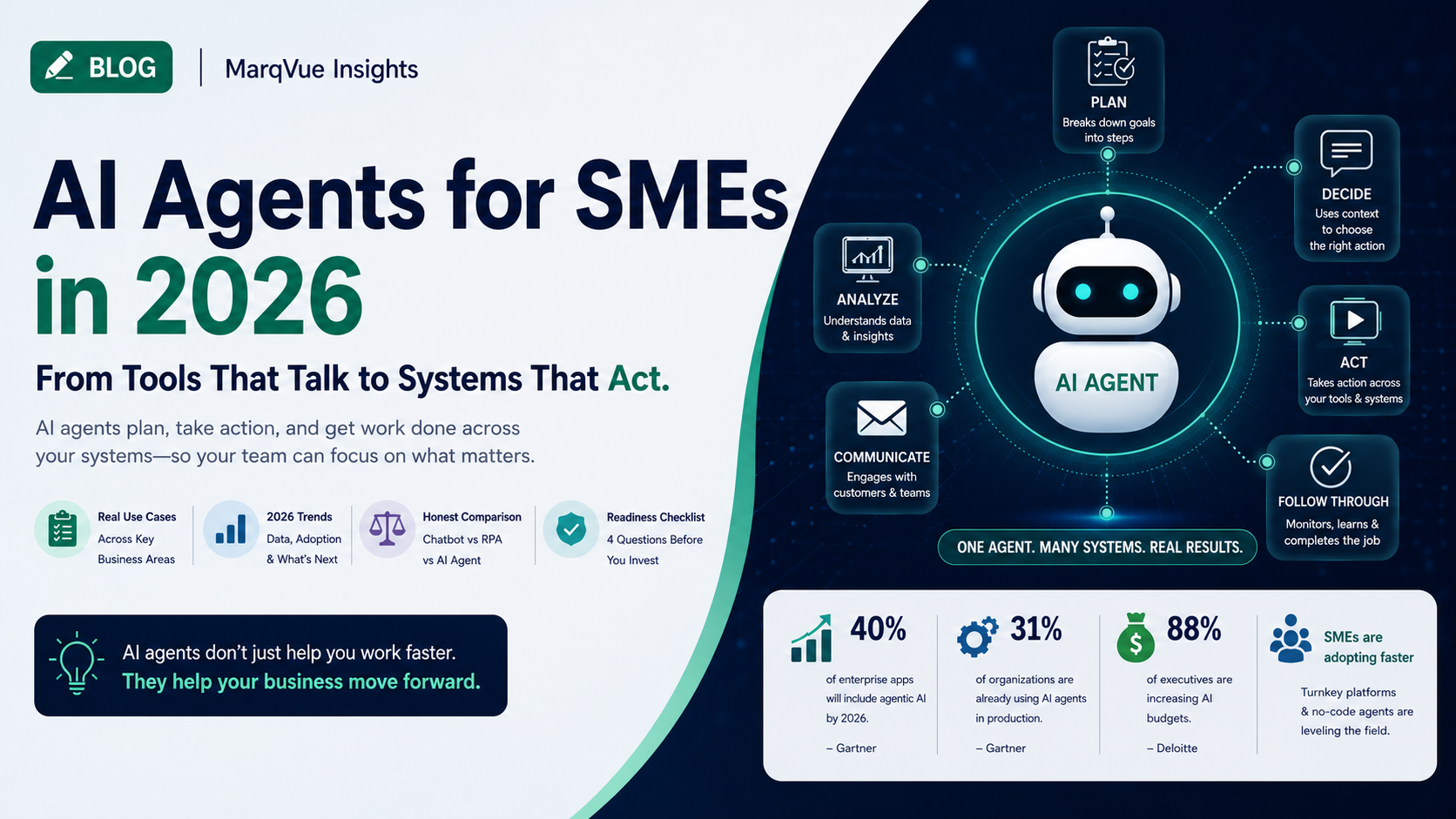
AI agents are fundamentally different from chatbots or generative AI tools — they plan multi-step tasks, take action across systems, and follow through with minimal human input. For SMEs, that's the difference between a tool that helps you write faster and one that actually does the work. What it covers: Definition — plain-language explanation of what an AI agent is vs. a chatbot vs. a generic AI writing tool Why 2026 matters — current adoption data (Gartner's 40% enterprise-app forecast, 31% production adoption, 88% of executives increasing AI budgets), plus an honest note that SMEs are actually adopting faster than large enterprises thanks to turnkey platforms Real use cases — sales/lead management, customer support & WhatsApp automation, marketing ops, internal reporting, finance/back-office tasks Comparison table — chatbot vs. RPA vs. AI agent, side by side Readiness checklist — four honest questions a business should ask before investing (repeatable task? clean data? clear owner? starting narrow?) Firsthand experience section — patterns MarqVue has seen directly with SME clients (what works, why pilots stall) 7-question FAQ — covers cost, risk, ROI timeline, job displacement, and what to automate first Sources & author credibility block — linked references, author bio, reviewer credit, schema recommendations
July 12, 2026
By Bilal Ahmed , Marketing, AI & Automation Lead at MarqVue · Reviewed by Umar Ali
· Updated July 12, 2026 · 9 min read
MarqVue has been building websites, marketing systems, and — since 2023 — AI agents and automation workflows for SMEs across the US, UAE, and GCC. The observations on adoption patterns and pilot failures below reflect what we’ve seen directly in client implementations, cross-checked against the latest 2026 industry research.
If you’ve spent any time online this year, you’ve probably seen the phrase “AI agents” everywhere — in your LinkedIn feed, in vendor emails, in conversations with other business owners. It’s easy to dismiss it as another buzzword. It isn’t.
An AI agent is different from the chatbot or the generative AI tool you’re already used to. It doesn’t just answer a question or draft a paragraph — it plans a task, takes action across your systems, and follows through until the job is done, with little or no hand-holding. For a small or mid-sized business, that distinction is the difference between a tool that helps you write faster and a tool that actually does the work.
This guide breaks down what AI agents for business really are, where they’re already delivering results, what to watch out for, and how to figure out if your business is ready for one.
What Is an AI Agent, Exactly?
An AI agent is a software system built on a large language model that can understand a goal, break it into steps, use tools or software to complete those steps, and adjust its approach based on what happens along the way — largely without a human directing every move.
The easiest way to understand the difference is to compare it with what most businesses already use:
A chatbot answers questions inside a conversation. It’s reactive.
A generative AI tool (like a writing assistant) produces content when you ask. It’s a single output.
An AI agent pursues a goal across multiple steps and systems — checking a calendar, updating a CRM, sending a follow-up, flagging an exception — without needing a prompt for every single action. It’s proactive and multi-step.
Put simply: a chatbot talks, an AI agent works.
Why AI Agents for Business Matters Right Now
The shift toward agentic AI isn’t a future trend — it’s already reshaping how enterprise software is built. Analysts at Gartner have projected that roughly 40% of enterprise applications will contain task-specific AI agents by the end of 2026, up from under 5% just a year earlier.[¹] Separate research from S&P Global Market Intelligence and McKinsey puts current production adoption at around 31% of enterprises, with banking and insurance leading the way.[²]
Executive appetite backs this up. Multiple 2026 surveys — including reporting from Accelirate and PwC — point to roughly 88% of senior executives planning to increase AI-related budgets specifically because of agentic AI initiatives, and companies already using agents report meaningful productivity gains and cost savings.[³]
For small and mid-sized businesses specifically, the practical takeaway is this: agentic tools built on platforms like Salesforce Agentforce or Microsoft Copilot Studio have made this technology accessible without an enterprise IT budget. Research from First Page Sage notes that SMBs and mid-market companies are now adopting agentic AI faster, year over year, than large enterprises — largely because these turnkey solutions remove the heavy technical lift that used to make this the domain of Fortune 500 companies only.[⁴]
The honest caveat: not every deployment succeeds. Industry data also shows a real gap between businesses experimenting with agents and those running them successfully in production, often due to unclear scope, weak data foundations, or no one owning the outcome. The businesses seeing real ROI are the ones that start with a narrow, well-defined task — not a company-wide AI overhaul on day one.
What AI Agents Actually Do for Businesses (Real Use Cases)
AI agents work best when they’re given a specific, repeatable job rather than a vague mandate to “use AI.” Here’s where they’re delivering measurable value today:
Sales & Lead Management Agents can qualify inbound leads, enrich contact records, prioritize follow-ups by likelihood to convert, and draft personalized outreach — freeing sales reps to spend time on conversations, not admin.
Customer Support & WhatsApp Automation Rather than a scripted chatbot, an AI agent can look up an order, check a policy, resolve a routine issue, and only escalate to a human when the situation genuinely needs judgment.
Marketing Operations Agents can draft campaign briefs, generate on-brand copy variations, monitor performance, and flag underperforming ads — compressing work that used to take a marketing coordinator hours into minutes.
Internal Operations & Reporting From compiling weekly reports to routing internal requests and monitoring recurring workflows, agents handle the repetitive administrative layer that quietly eats into a small team’s week.
Finance & Back-Office Tasks Agents can flag anomalies, reconcile records, and prepare summaries for human review — reducing manual data entry without removing human oversight from financial decisions.
Across these categories, PwC’s 2026 AI Business Predictions survey found companies using AI agents reported meaningful productivity gains and cost savings — figures consistent with what we’re seeing directly with clients across the US, UAE, and GCC.
AI Agents vs. Chatbots vs. Automation: What’s the Real Difference?
Feature | Traditional Chatbot | RPA (Robotic Process Automation) | AI Agent |
|---|---|---|---|
Handles unscripted requests | Rarely | No | Yes |
Works across multiple tools | No | Sometimes (rule-based) | Yes |
Adapts to new situations | No | No | Yes, within scope |
Needs constant reprogramming | Yes | Yes | Less often |
Best for | Simple FAQs | Fixed, repetitive tasks | Multi-step goals with some variability |
If your business already uses a chatbot or basic automation and it’s working, you don’t need to rip it out. AI agents are best introduced where the current tool hits its limit — where a task needs judgment, context, or coordination across more than one system.
How to Know If Your Business Is Ready for an AI Agent
Before investing, it’s worth being honest about a few things:
Is there a specific, repeatable task eating up hours every week? Agents perform best on well-defined jobs, not open-ended ones.
Is your data reasonably organized? An agent pulling from a messy CRM or disconnected spreadsheets will inherit that mess.
Does someone own the outcome? Deployments without a clear internal owner are far more likely to stall before reaching real use.
Are you starting narrow? The businesses getting real value tend to pilot one workflow, prove it out, and expand — not attempt to automate everything at once.
What We’ve Seen Firsthand
Working with SMEs across the US, UAE, and GCC, the pattern above plays out consistently in practice. Clients who come to us wanting to “add AI everywhere” almost always end up scaling back to a single workflow first — usually lead follow-up or WhatsApp customer support — because that’s where the labor is most repetitive and the ROI is easiest to measure within the first month.
The businesses that stall are almost never held back by the AI model itself. They’re held back by disorganized CRM data, no single owner for the pilot, or leadership expecting full autonomy on day one instead of a supervised rollout. That matches what the broader 2026 research shows: the technology is ready; the organizational readiness usually isn’t.
Getting Started the Right Way
The businesses that get the most out of AI agents typically follow a similar path: they pick one high-friction task, build a scoped pilot around it, measure the actual time or cost saved, and only then expand to a second workflow. That’s a very different approach from buying a broad “AI transformation” package and hoping it works — and it’s the approach we use with SME clients across marketing, sales, and operations.
FAQs About AI Agents for Business
What is an AI agent in simple terms? An AI agent is software that can understand a goal, plan the steps needed to achieve it, and carry out those steps across different tools or systems — largely without a person directing every action.
Are AI agents the same as chatbots? No. A chatbot responds within a single conversation. An AI agent can take multi-step action across systems — updating records, triggering follow-ups, or completing a task end-to-end — with far less human input.
Can small businesses actually afford AI agents? Yes. Turnkey agentic platforms have made this far more accessible than it was even two years ago. Most SMEs start with one scoped use case, such as lead qualification or customer support automation, rather than a full enterprise deployment.
What tasks should a business automate first with an AI agent? Start with a high-volume, repetitive task that already has a clear process — such as lead follow-up, FAQ handling, or report compilation — rather than a complex or judgment-heavy workflow.
What’s the biggest risk with AI agents? The most common failure point isn’t the technology — it’s unclear scope, poor data quality, or no one internally owning the outcome. Narrow, well-owned pilots succeed far more often than broad rollouts.
How long does it take to see ROI from an AI agent? Industry surveys report a median payback period of roughly 3–9 months depending on the function, with simpler use cases like sales follow-up automation typically paying back faster than complex finance or operations workflows.
Do AI agents replace employees? In practice, most successful deployments use agents to absorb repetitive volume while employees handle exceptions, judgment calls, and relationship-based work — not to replace roles outright.
Sources
Gartner, enterprise application forecast, 2026
S&P Global Market Intelligence & McKinsey, production adoption data, 2026
Accelirate / PwC, 2026 AI Business Predictions, executive budget survey
First Page Sage, Agentic AI Adoption Statistics, 2026
Figures reflect third-party industry research current as of publication. Adoption and market-size estimates vary across research firms depending on methodology; we’ve cited the original source for each figure so you can verify and go deeper.
About the Author
Bilal Ahmed leads AI and automation delivery at MarqVue, where the team has built websites and marketing systems for SMEs since 2008 and AI agents/automation workflows since 2023, across the US, UAE, and GCC. Connect on LinkedIn →
Reviewed for accuracy by Umar Ali.
Ready to see where an AI agent could save your team real hours? Talk to MarqVue about a scoped AI agent pilot for your business.
Author
Bilal Ahmed
AI & Automation Lead, MarqVue
LinkedIn: https://www.linkedin.com/in/bilalahmed1/