UAE Digital Marketing Trends 2026: Where the $2.64B in Ad Spend Is Actually Going
UAE digital ad spend hits $2.64B in 2026. See exactly where it's going by channel, and what the shift means for your marketing budget.
August 27, 2026
By Bilal Ahmed, Founder, MarqVue
UAE digital ad spend is projected to reach US$2.64 billion in 2026, up 15.2% year over year. Growth is concentrated in retail media, connected TV, social video, and WhatsApp-based commerce, channels that reward measurable, outcome-driven spending over traditional awareness advertising.
Most UAE businesses are still budgeting the way they did two years ago. Same split between Google Search and Meta, same rough percentages, same channels they picked back when those channels made sense. Meanwhile, the market itself has already moved on.
In 2026, digital ad spend here is set to hit US$2.64 billion, and it isn't spreading evenly across the channels most SMEs are used to. That number by itself doesn't tell you much. What matters is where the money is actually going.
I've been running marketing campaigns in this region since 2008, long enough to watch a few of these shifts happen in real time. The pattern is always the same: the market moves first, budgets catch up a year or two later, and the businesses that catch up early get a real head start. This piece breaks down exactly where the money is moving in 2026, and what that shift actually means if you're working with a real, limited budget instead of an enterprise one.
How Big Is the UAE Digital Ad Market in 2026, Really?
The UAE digital ad spend market is projected to reach US$2.64 billion in 2026, up 15.2% from the year before, according to Research and Markets. That follows a 12.8% compound annual growth rate between 2020 and 2025, so this isn't a sudden spike, it's a market that's been accelerating for a while.
A lot of trend articles get sloppy here, so let's be upfront about it: that $2.64 billion figure is for the UAE as a whole. It's not the same as Dubai's individual ad spend, which sits closer to $1.2-1.4 billion on its own, and it's a fraction of the broader MENA region's digital ad market, which crossed $8.185 billion in 2025 according to IAB MENA. If you've seen different numbers floating around in other "2026 trends" articles, that's usually why, they're measuring different things and calling it the same market.
Why does this matter beyond just getting the number right? Because if you're planning a budget based on UAE-wide growth but benchmarking your results against Dubai-only figures, or vice versa, you're comparing apples to a fruit basket. Getting the scope right is step one before any budget decision makes sense.
Where the Money Is Actually Going (By Channel)
One more scope note before we get into channels: the growth rates below come from IAB MENA's 2025 report, which covers the whole region, not the UAE in isolation. There's no public breakdown that isolates UAE-only channel growth. But the UAE is the region's most digitally mature market, near-universal internet access, one of the highest smartphone penetration rates anywhere, so when MENA-wide spending shifts, the UAE is usually leading that shift, not trailing it.
Where Enterprise Budget Is Going
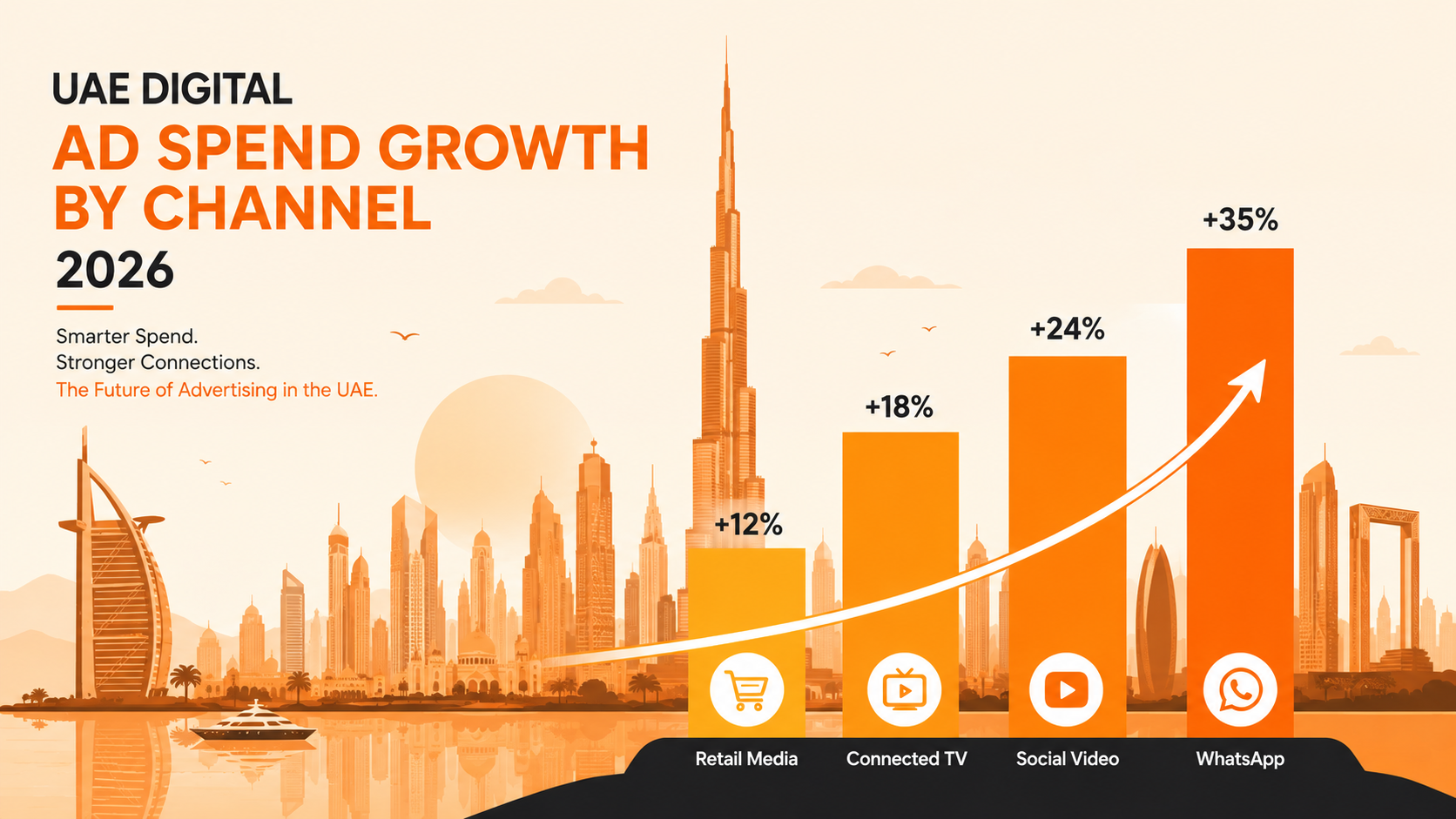
Two categories are pulling ahead fastest at the top end of the market. Retail media, ads placed directly on retail platforms and marketplaces, grew 40.5% year over year across MENA, the fastest-growing category IAB tracked. Connected TV, ads on streaming platforms, grew 31%, climbing from $307 million to $386 million in a single year.
Both matter mainly if you're operating at Noon, Amazon, or major-broadcaster scale. If you're not, don't chase these two directly. What matters for you is the principle behind them: spend is moving closer to the actual purchase decision and away from pure brand awareness. That principle shows up again below, in channels you can actually act on.
Social Video and Social Commerce (+23.6%)
Social video spend grew 23.6% year over year, and this is the category where SME budgets actually compete on a level playing field. TikTok Shop, Instagram Shopping, short-form video ads, none of this requires an enterprise media budget to execute well.
If your current content strategy is still mostly static images and the occasional boosted post, this is the gap. Video-first, commerce-integrated content is where regional attention is shifting, and it's one of the more affordable channels to actually shift your budget toward.
WhatsApp and Messaging Commerce
WhatsApp doesn't show up in most global ad spend reports because it isn't really an "ad channel" in the traditional sense, it's a direct commerce and conversation channel. But in the UAE and wider GCC, WhatsApp usage sits above 90% of the population according to DataReportal's 2026 UAE figures, making it arguably the single highest-leverage channel for a business your size.
This is the channel I'd point most SMEs toward first, not because it's trendy, but because it's where the region already spends most of its time, and it converts a conversation into a sale faster than almost anything else.
What's Actually Driving This Shift
A few things are pushing this growth at once. AI-powered programmatic buying keeps expanding, letting even smaller advertisers target audiences with a precision that used to require an enterprise media team. The UAE government's continued push toward a digital-first economy is making it easier for businesses to launch and scale online without the paperwork and infrastructure hurdles that used to slow things down. And with internet penetration sitting at 99% and mobile connections outnumbering people, there's simply very little reach barrier left in this market.
None of this is new information on its own. What's worth noticing is how these factors combine: more precise targeting, a population that's almost entirely online, and a government actively investing in digital infrastructure. That combination is why growth keeps accelerating instead of leveling off, and it's exactly why the channel shifts above aren't a temporary trend.
What This Means for Your Marketing Budget (Not a $2.64B One)
Here's the part that actually matters if you're running a business, not a market report.
You don't need to spend more. You need to spend differently.
I've seen this pattern play out with SMEs across the region more than once: a business locks in a marketing budget split, usually Google Search plus Meta ads, and it works well enough that nobody revisits it for two or three years. Meanwhile, where the region's ad dollars and attention are actually moving looks nothing like that split anymore.
If your current budget is still close to 100% search and social ads with no WhatsApp or video component, you're not doing anything wrong exactly, but you are behind where the market already is. The good news is that fixing this doesn't mean blowing up your entire strategy. It usually means shifting 15 to 25% of an existing budget toward one or two underused channels, most often WhatsApp-based automation and short-form video content, both of which cost less to execute than people assume.
The businesses that make this adjustment early tend to get a real head start, not because the channels themselves are magic, but because their competitors are still running the same budget split they set up in 2023.
Where to Go From Here
You don't need another trend report to know something needs to shift. What you need is fifteen minutes to actually look at your own numbers.
Pull up your last 12 months of ad spend and break it down by channel. Compare that split against what you just read here. If it's mostly search and social with nothing going toward WhatsApp or video, that gap is your starting point, not a reason to panic, just a reason to adjust.
Here's a concrete way to get a second opinion on it: send us your current channel split on WhatsApp, just a rough percentage breakdown of where your budget goes, and we'll reply with a short video walking through where you're likely overspending or underspending against this data. No pitch, just a straight read on your numbers.
Conclusion
The UAE's digital ad market isn't just growing, it's reallocating. Retail media, video, and WhatsApp-based commerce are pulling ahead while traditional splits stay flat. The businesses that notice this now and shift a portion of their budget accordingly will have a real advantage over the ones still running their 2023 strategy in 2026.
For a deeper look at how to tell a genuinely AI-powered marketing partner from an agency that's just rebranded, see our related guide on what an AI-powered marketing agency actually does.
Bilal Ahmed, Founder, MarqVue